
Ten years after the adoption of the Kigali Amendment, the United Nations Environment Programme’s United for Efficiency (UNEP-U4E) initiative has launched two Sustainable Procurement Guidelines that give governments a practical route to meeting their global commitment with greener public purchasing of cooling and heating by 2030.The publications include an updated Sustainable Procurement Guidelines for Energy-Efficient and Climate-Friendly Air Conditioners and Air-to-Air Heat Pumps, alongside a new Sustainable Procurement Guidelines for Heating and Hot Water Systems Using Heat Pumps. The two Guidelines were officially announced by Patrick Blake, UNEP-U4E Programme Manager, during the Global Cooling Pledge Assembly in Singapore, underscoring the role of sustainable procurement in accelerating the uptake of efficient, climate-friendly technologies.
2026 marks the tenth anniversary of the adoption of the Kigali Amendment to the Montreal Protocol. The Thirty-Eighth Meeting of the Parties to the Montreal Protocol (MOP38) returns to Kigali from 2 to 6 November 2026, where the Guidelines will be highlighted in side events. As countries advance implementation of the Kigali Ammendment, sustainable procurement can play a complementary role by encouraging the uptake of energy-efficient cooling technologies using lower-GWP refrigerants.
Public procurement, in particular, can be a powerful driver of market transformation. It represents around 12 per cent of GDP in OECD countries and can reach up to 30 per cent in many developing economies. By directing this purchasing power towards better-performing technologies, public authorities can reduce energy use, operating costs and emissions, while creating clearer demand signals for efficient and lower-emission products and systems.
Together, the Guidelines provide technical criteria, verification requirements and practical tools that can be incorporated into procurement policies, programmes and tender documents. They are designed to help purchasers look beyond upfront purchase price and consider performance, costs and environmental impacts over the product or system lifetime, from energy efficiency and refrigerant choice to installation, maintenance, durability, operating costs and environmentally sound end-of-life management.
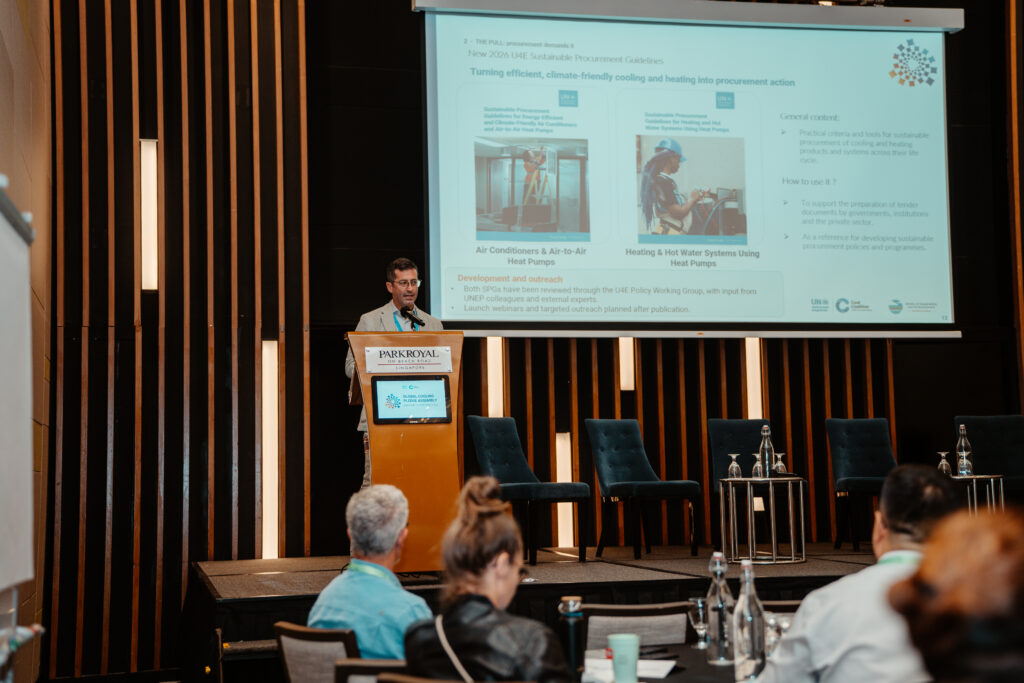
Patrick Blake, UNEP-U4E Programme Manager, announced the two Sustainable Procurement Guidelines during the Global Cooling Pledge Assembly in Singapore.
Turning sustainable cooling goals into procurement action
The updated Sustainable Procurement Guidelines for Energy-Efficient and Climate-Friendly Air Conditioners and Air-to-Air Heat Pumps provide practical guidance for procuring efficient, climate-friendly and fit-for-purpose cooling and heating equipment. Covering air conditioners and reversible air-to-air heat pumps with rated cooling output of up to 70 kW, the Guidelines are designed to support both tender preparation and broader sustainable procurement policies.
The publication sets out procurement criteria covering equipment sizing and operating conditions, energy performance, controls, lower-GWP refrigerants, safety, sound levels, installation, maintenance, warranties, spare parts and end-of-life management. It also encourages procurers to assess cooling and heating needs before purchasing new equipment and to consider opportunities to reduce demand and improve overall system performance.
Humidity is a particular focus for hot and humid climates, including much South and South-East Asia. In these conditions, a large share of an air conditioner’s energy goes into removing moisture from the air rather than lowering its temperature. Oversized or poorly controlled equipment often overcools spaces in order to dehumidify them, wasting energy and reducing comfort. By addressing sizing, operating conditions and controls, the Guidelines help procurers select equipment that manages both temperature and humidity efficiently.The Guidelines complement U4E’s Model Regulation Guidelines for Energy-Efficient and Climate-Friendly Air Conditioners and Air-to-Air Heat Pumps. While the Model Regulation Guidelines support governments in establishing minimum market requirements, sustainable procurement can help large buyers go further by creating demand for higher-performing products.
They also complement efforts to implement the Kigali Amendment by encouraging the adoption of lower-GWP refrigerants alongside higher energy efficiency. They further support the Global Cooling Pledge, under which national participants committed to establish or update public procurement policies and guidance for low-GWP and high-efficiency cooling technologies by 2030. By translating these objectives into practical procurement criteria and tools for comparing compliant offers, the Guidelines can help turn policy commitments into purchasing action.
Supporting more efficient heating and hot water systems
The new Sustainable Procurement Guidelines for Heating and Hot Water Systems Using Heat Pumps provide stand-alone guidance for the procurement of heat-pump-based space heating and sanitary hot water systems, supporting the transition from conventional heating technologies to more efficient heat pump solutions. The Guidelines cover water-based systems supplied primarily by electrically driven heat pumps, including those using air, ground, water and waste heat as heat sources.
A key feature of the publication is its system-level approach. The performance of a heat pump system depends not only on the efficiency of the heat pump itself, but also on how the overall system is designed, sized, installed and operated. The Guidelines therefore address factors such as operating temperatures, heat distribution systems, controls, buffer and hot water storage, alongside energy performance, refrigerant requirements, safety, sound levels, maintenance, technical capacity and end-of-life management.
This broader approach helps procurers consider the performance of the entire heating and hot water system over its lifetime, rather than evaluating individual equipment in isolation. It also supports purchasing decisions that take account of local climate, building characteristics, user needs and available heat sources, helping ensure that systems are appropriately designed for their intended application.
Applying the Guidelines in practice
Both Guidelines include evidence and verification provisions and are accompanied by a U4E Excel tool for Life Cycle Cost (LCC) and Emissions assessment, enabling procurers to compare compliant offers based not only on initial purchase price, but also on energy consumption, operating costs and greenhouse gas emissions.
The publications also address wider sustainability considerations, including maintenance and repair, availability of spare parts, environmentally sound end-of-life treatment, decent work, gender equality and safe and inclusive working conditions. Their recommendations can be adapted to national and regional market conditions and procurement frameworks.
In addition to public authorities, the Guidelines can be used by private companies, utilities, non-governmental organisations and other large buyers, and can serve as references for policymakers developing or strengthening sustainable procurement policies and programmes.
Download the Sustainable Procurement Guidelines for Energy-Efficient and Climate-Friendly Air Conditioners and Air-to-Air Heat Pumps [here].
Download the Sustainable Procurement Guidelines for Heating and Hot Water Systems Using Heat Pumps [here].