
On 15 July 2026, UNEP’s United for Efficiency initiative (UNEP-U4E) brought together government representatives and technical experts at the 48th Meeting of the Open-ended Working Group of the Parties to the Montreal Protocol (OEWG48) in Bangkok to discuss how countries can accelerate the transition towards more efficient and lower-GWP cooling.
The side event, “Aligning Cooling Policies with Best Practice: Energy Efficiency, Refrigerants and Implementation Pathways,” focused on the practical steps needed to translate international best practice into policies that can be implemented and enforced.
A central message from the discussion was that energy efficiency and refrigerant transition policies may be implemented through different instruments, but should be coordinated to provide a clear and predictable direction for the market.
The session was opened by Sudhir Sharma, Regional Coordinator at UNEP’s Asia and the Pacific Office. Miquel Pitarch, Cooling Expert at UNEP-U4E, then introduced U4E tools and guidance supporting countries in developing efficient and climate-friendly cooling product policies.
The moderated discussion brought together Yaru Mahmud Nurudeen from Nigeria’s National Ozone Office; Pearl Nkusi from the Rwanda Environment Management Authority; Hubert Nsoh Zan from the Ghana Energy Commission; Yang Yuzhou from the China Household Electric Appliance Research Institute (CHEARI); and Nils Hansen from GIZ Proklima.
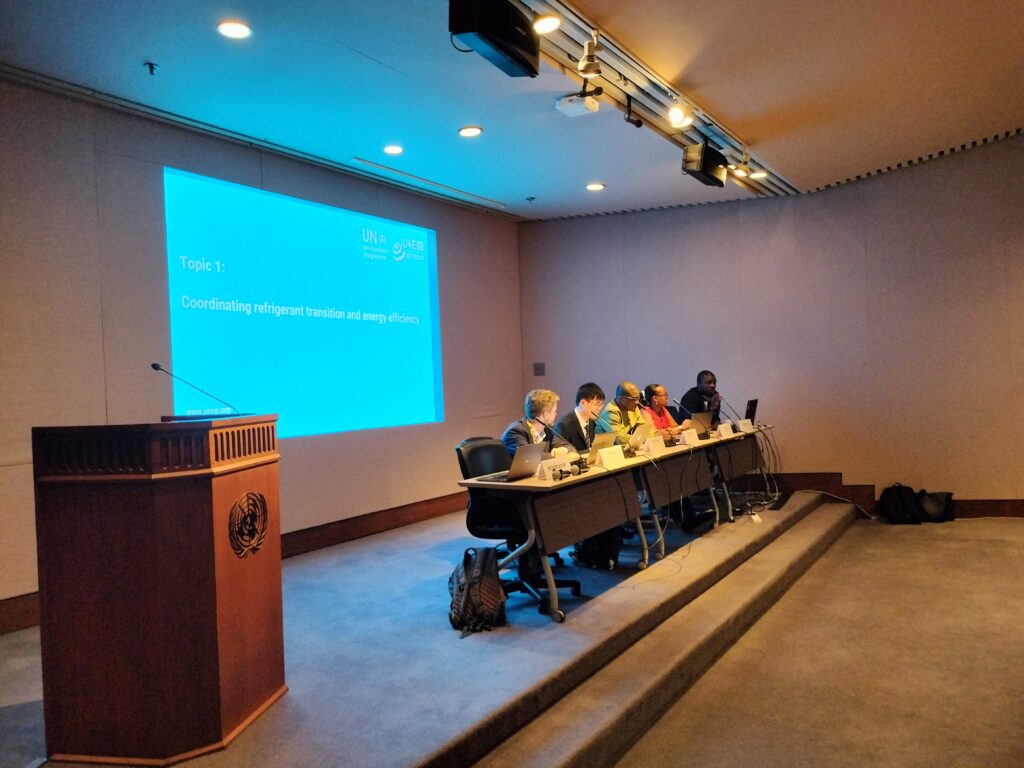
Speakers at the UNEP-U4E side event during OEWG48 in Bangkok.
Preparing markets for the transition
Participants emphasized that adopting new requirements is only one part of the transition. Countries also need to prepare the systems and markets that will make those requirements work in practice, including product availability, testing and registration systems, market surveillance and enforcement, as well as safety requirements and trained installation and servicing technicians.
“Where efficient, lower-GWP technologies are already technically and commercially ready, countries should not wait for the minimum Kigali timelines. We need to prepare our markets now so that these sectors can transition faster, while ensuring that the necessary implementation, enforcement and technical capacity is in place.”
— Hubert Nsoh Zan, Energy Commission, Ghana
Learning from country experience
The discussion highlighted different approaches already being taken by countries.
Ghana shared experience in linking energy efficiency with information on refrigerant impacts. Alongside its appliance efficiency labelling programme, Ghana has introduced voluntary refrigerant labels for air conditioners and refrigerators/freezers. The labels compare refrigerants using their climate impact over a 20-year period and provide information on other environmental characteristics, identifying natural refrigerants such as R290 and R600a as PFAS-free.
Rwanda discussed its work to incorporate both energy-efficiency and refrigerant-related requirements into the same regulation, including a centralized Product Registration System framework that can support implementation and compliance across different product types and requirements.
Nigeria shared its experience with market surveillance and preparations for upcoming cooling product requirements, highlighting the institutional and practical arrangements needed to move from regulation to effective enforcement.
The technical contributors complemented these country perspectives. CHEARI (China Household Electric Appliance Research Institute) shared developments in air-conditioner testing and performance assessment in China, while GIZ Proklima reflected on lessons from supporting refrigerant transitions, energy efficiency, safety and capacity building across different countries.
The discussion generated significant audience participation, with questions focusing particularly on how country experiences could be applied in other markets and how policy ambition can be matched with implementation readiness.
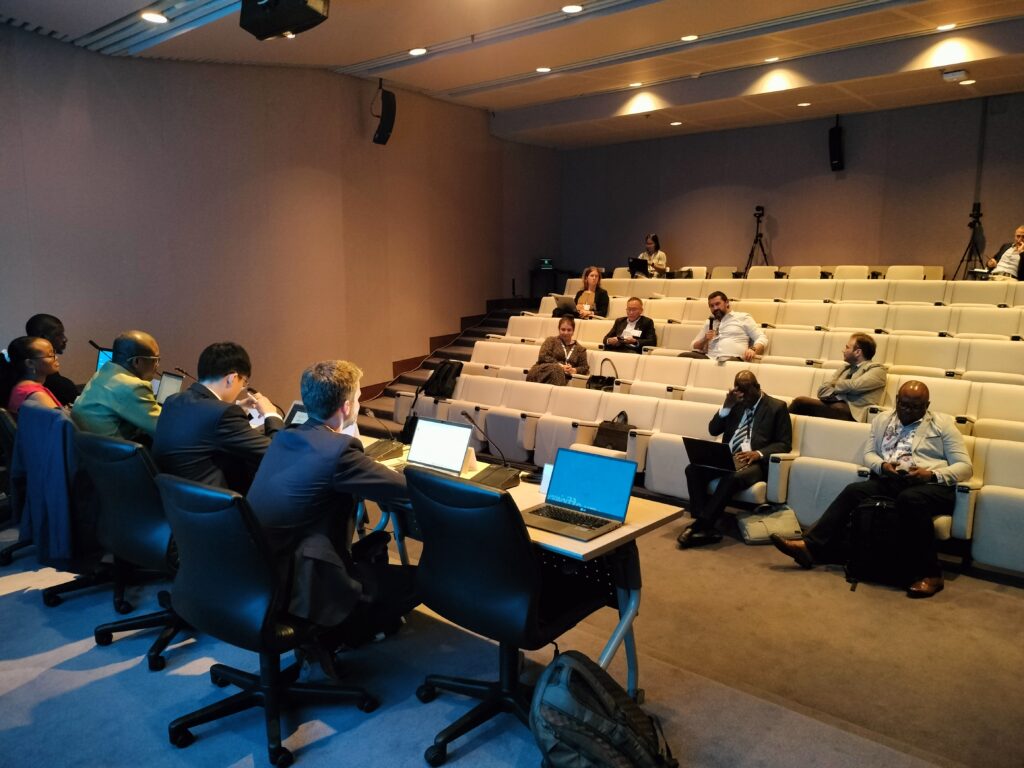
Exchange among speakers and participants during the UNEP-U4E side event at OEWG48.
From international guidance to implementation
UNEP-U4E presented the updated Model Regulation Guidelines for Air Conditioners and Air-to-Air Heat Pumps, which provide a reference for countries developing or revising policies such as Minimum Energy Performance Standards (MEPS), energy labels and refrigerant-related requirements.
The presentation also highlighted U4E Country Savings Assessments, which quantify the potential energy, financial and emissions benefits of stronger product policies, together with other U4E resources supporting sustainable procurement and policy implementation.
The exchange reinforced the importance of using international best practice to guide national and regional policy development, while planning realistic pathways for implementation. Local conditions may influence how and when countries introduce new requirements, but the objective should be to progressively move markets towards higher efficiency and lower-GWP technologies, with clear timelines and increasing ambition as market readiness improves.
The event also showed the value of bringing together institutions that often work through separate policy processes. Energy authorities, National Ozone Units, standards bodies, environmental agencies and technical partners each have a role in ensuring that efficiency improvements and refrigerant transitions reinforce one another.
By connecting international technical guidance with practical country experience, the OEWG48 side event provided a forum to share approaches, compare experiences and discuss how countries can move from policy design towards effective implementation, compliance and market transformation. UNEP-U4E will continue working with countries, partners and industry to support stronger cooling product policies and accelerate the transition towards higher-efficiency and lower-GWP technologies.