The first-ever Festival of Cooling brought together farmers, students, innovators, and policymakers for a week-long celebration of sustainable cooling at the Africa Centre of Excellence for Sustainable Cooling and Cold-chain (ACES) in Kigali. From October 7–10, the event transformed ACES into a vibrant hub of innovation, creativity, and collaboration, showcasing how cooling can drive climate action, food security, and economic growth across Africa.

© Clean Cooling Network
A Festival with Purpose
Unlike a traditional conference, the Festival blended science, art, and entrepreneurship to inspire practical action. Over four dynamic days, participants took part in demonstrations, policy discussions, innovation pitches, exhibitions, and training sessions — all centred on a system that keeps food fresh, medicines safe, and economies resilient: the cold chain.
The event was co-organized by UNEP’s United for Efficiency (U4E), the University of Birmingham, the Clean Cooling Network and ACES, with support from the UK Government. Together, these partners are turning Kigali into a global reference point for sustainable cooling solutions.
Day 1 – Cooling for Health
The Festival opened with a focus on the health sector, highlighting the life-saving role of cold-chains in vaccine delivery and storage. Demonstrations showed how drones can deliver vaccines directly to rural clinics with unreliable electricity, reducing losses that compromise up to 50% of doses in some areas.
“What we’re doing is finding ways to deliver vaccines while maintaining the correct temperature. We’re improving cooling systems and exploring how to use new technologies, such as drones, to transport vaccines. For me, this is really about how we can mitigate the losses we’re seeing — 25% of vaccines and 37% of food are lost. That’s economic value, that’s investment, and that’s people’s lives. This is why the cold chain is critical infrastructure,” said Professor Toby Peters, Programme Director of ACES.
Day 2 – Inspiring the Next Generation
Education took centre stage as students from eight Rwandan schools discovered the science — and art — of cooling. Through hands-on activities like building mini refrigeration systems and copper-cutting exercises, students connected classroom theory to real-world solutions.
“Here, I’ve seen how the systems actually work. I can now relate theory to real equipment,” said Aimé Arcade Mpano, a student at Nyamata Technical Secondary School.
Day 3 – Innovation and Entrepreneurship
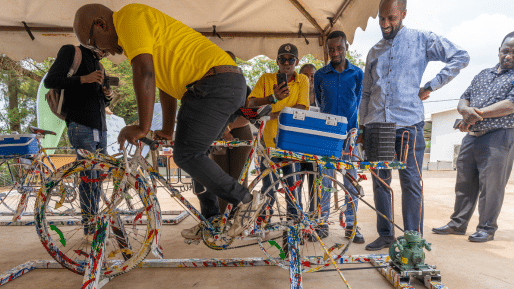
Day 3 celebrated the creativity of African entrepreneurs. Start-ups presented cutting-edge innovations — from solar-powered grain dryers to IoT livestock monitoring systems — and met with experts to refine their prototypes and business models.
© Clean Cooling Network
“We developed a prototype and are now looking for partners to scale up,” said Patrick Ndayisaba, Founder of Greenover Africa, whose team helps small farmers reduce post-harvest losses.
Day 4 – Farmers and Policymakers in Action
The closing day brought farmers face-to-face with decision-makers, including Baroness Chapman of Darlington, Hon. Dr. Bernadette Arakwiye, Rwanda’s Minister of Environment, and Hon. Telesphore Ndabamenye, Minister of State for Agriculture and Animal Resources.
Farmers explored solar-powered cold rooms, temperature-monitoring tools, and financing models such as cooling-as-a-service — practical solutions to reduce post-harvest losses, which claim up to 50% of perishable produce in some regions.
“As the Festival of Cooling wraps up, ACES demonstrates how global agreements such as the Kigali Amendment and the Montreal Protocol can deliver tangible local impact through strong partnerships and local ownership,” said Hon. Dr. Bernadette Arakwiye.

© Clean Cooling Network
A Blueprint for the Future
The Festival of Cooling proved that sustainable cooling is far more than a technical challenge — it’s a social, economic, and environmental opportunity. It showcased how collaboration between governments, academia, industry, and communities can turn ideas into action and make the benefits of cooling accessible to all.
With continued support from its partners, ACES will build on this momentum to train more farmers, strengthen national policies, and expand access to efficient, climate-friendly cooling solutions across Africa.
About ACES
The Africa Centre of Excellence for Sustainable Cooling and Cold-chain (ACES) is a collaborative initiative led by UNEP’s United for Efficiency (U4E), the University of Birmingham, the Government of Rwanda, and Rwandan academic partners, with support from the UK Government. ACES helps farmers and businesses access sustainable cold-chain technologies and training, promoting green growth, resilience, and inclusive economic development.
Learn more about ACES and the Festival of Cooling at the Clean Cooling Network website.


Leave a Reply