A new high-level Task Force on cooling, a regional roadmap for refrigerator standards, and a strengthened framework for Mutual Recognition Arrangements were among the key outcomes agreed at the 3rd Meeting of the ASEAN EE&C-SSN Working Group on Appliances, held in Jakarta on 9 March 2026. With the new APAEC 2026–2030 cycle underway, the meeting marked a pivotal moment in ASEAN’s ambition to accelerate the transition to energy-efficient, climate-friendly appliances across the region.

Bringing together representatives from ASEAN Member States (AMS), the ASEAN Centre for Energy (ACE), and international partners, including UNEP’s United for Efficiency (U4E), the meeting reviewed progress on air conditioners, lighting, refrigerators, and the regional Product Registration System, while setting concrete milestones for the years ahead.
Advancing the ASEAN COOL Strategy
A central highlight of the meeting was U4E’s presentation on the proposed ASEAN COOL Strategy, which builds on the successful ASEAN Cool Initiative. The strategy, to be implemented in 2026–2027 in partnership with the ASEAN Centre for Energy (ACE), aims to accelerate market transformation toward energy-efficient and climate-friendly cooling across the region, covering room air conditioners (RACs), residential refrigerators, and the transition to low-global-warming-potential (GWP) refrigerants.
Key objectives of the ASEAN COOL Strategy include:
- Strengthening regional governance and political alignment on ambitious RAC Minimum Energy Performance Standards (MEPS) at the ministerial level;
- Providing technical support to harmonise MEPS for residential refrigerators;
- Developing a Regional Savings Assessment for refrigerators;
- Benchmarking High Energy Performance Standards (HEPS) for RACs and providing guidance for sustainable procurement policies.

At the heart of the strategy is a proposed dedicated platform, to be co-led by ACE and U4E, which will facilitate high-level knowledge exchange, accelerate adoption of the regional roadmap, and address technical and policy challenges collaboratively across Member States. The meeting agreed in principle to establish the Task Force, with next steps including the circulation of Terms of Reference (TOR), the nomination of senior national focal points, and an inaugural meeting.
The Chair of the Working Group encouraged ASEAN programmes to prioritise promoting natural refrigerants alongside ongoing MEPS efforts, including pilot projects for low-GWP refrigerant systems suited to ASEAN’s tropical climate.
Progress on Room Air Conditioners
The meeting reviewed findings from the regional RAC market assessment, which pointed to encouraging trends: growing penetration of inverter models, a broad market shift toward R-32 refrigerant, and a narrowing price gap between inverter and fixed-speed units. Furthermore, a study in the region found that inverter models achieved approximately 22% energy savings over fixed-speed equivalents.
On regulatory alignment, Singapore has already adopted the CSPF 6.09 standard (effective April 2025), with Malaysia set to follow by 2030. Other AMS acknowledged challenges in meeting the regional target and called for targeted technical assistance for Cambodia, Lao PDR, Myanmar, and Timor-Leste to finalise national roadmaps and labelling frameworks. Delegates also supported piloting Green Public Procurement (GPP) guidelines and developing a Market Verification and Enforcement (MVE) handbook to strengthen compliance.
Refrigerators, MRAs, and Emerging Priorities
ACE is developing a Regional Policy Roadmap for Energy Efficient Household Refrigerators, with a draft expected by June–July 2026. The group recommended prioritising the 140–300-litre segment for maximum energy-saving impact, and U4E’s expertise will be sought in metric selection and threshold setting.
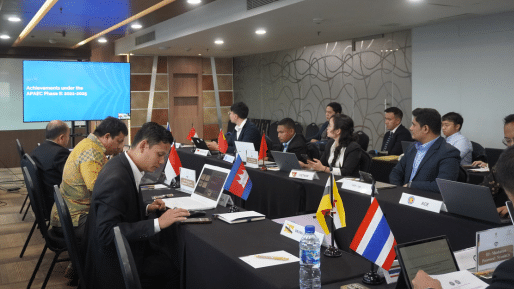
On Mutual Recognition Arrangements (MRAs), delegates agreed in principle that the Working Group on Appliances will lead the energy-efficiency components of the ASEAN Electrical & Electronic Equipment (EEE) MRA, with ACE as the technical secretariat. ACE was tasked with drafting the Terms of Reference and initiating nominations for national designated bodies.
It was emphasised that the Regional PRS Database Platform serves as a robust, reliable tool for monitoring, verifying, and enforcing the implementation of MEPS for appliances.
Looking ahead, circular economy principles were flagged as a priority for future regional activities, reflecting the Working Group’s broader commitment to sustainable appliance lifecycle management. For a full account of the meeting’s discussions and outcomes, visit the official summary published by the ASEAN Centre for Energy
For further information on U4E’s work in ASEAN, please contact Saikiran Kasamsetty at saikiran.kasamsetty@un.org or Zafe Fazilah Abu Bakar at zafe.fazilah@un.org.