NAIROBI, November 2025: As Africa faces unprecedented cooling demand driven by rising temperatures and rapid urbanization, policymakers and technical experts from the East African Community (EAC) and beyond gathered in Nairobi to chart a sustainable pathway for the region’s cooling sector.

Convened by the United Nations Environment Programme’s United for Efficiency (UNEP-U4E) and the United Nations Industrial Development Organization (UNIDO), two strategic events—a full day workshop and a side event—were held alongside the Thirty-Seventh Meeting of the Parties to the Montreal Protocol (MOP37). The workshop on Scaling Up Energy-Efficient Cooling Appliances in Africa (1 November 2025) and a side event on Harmonizing Energy-Efficient Cooling Regulations in Africa and Beyond (3 November 2025) brought together government representatives, regional bodies, international organizations, and development partners.
Regional Progress on Minimum Energy Performance Standards
The events focused on accelerating the adoption of regionally harmonized Minimum Energy Performance Standards (MEPS) for energy-efficient and climate-friendly cooling appliances (such as room air conditioners and refrigerators) within the EAC region.
“Africa has an opportunity to leapfrog to efficient, climate-friendly cooling solutions that meet growing demand without overburdening power systems,” said Patrick Blake, Programme Management Officer at UNEP-U4E. “Through harmonized regional standards and strong partnerships, we can reduce emissions, save energy, and lower costs for consumers,” he added.
Representatives from EAC Member States—Burundi, the Democratic Republic of the Congo, Kenya, Rwanda, Tanzania, Uganda, Somalia, and South Sudan—alongside participants from South Africa, Sierra Leone, Liberia, Zimbabwe, and Nigeria reviewed progress on the EAC’s recently approved regional MEPS for air conditioners and refrigerators. These were developed with the support of UNEP-U4E, UNIDO, and the East African Centre of Excellence for Renewable Energy and Energy Efficiency (EACREEE). These standards are now being adopted and implemented by EAC Member States.
Implementation Roadmap and Priority Actions
During the breakout discussions, participants identified critical support needs and priority interventions to accelerate national implementation. Key priorities include establishing facilities, reviewing and domesticating MEPS into national policies, launching pilot projects, and strengthening training for testing and enforcement officers. Participants also emphasized the importance of public awareness campaigns and enhanced institutional coordination.

Countries such as Kenya, Nigeria, and South Africa shared insights from their ongoing MEPS implementation efforts, providing valuable models for EAC countries to build upon. Oluyomi Banjo, UNIDO’s Industrial Development Officer, cited examples of UNIDO programmes that could support the adoption and implementation of MEPS in EAC Member States.
Collins Owuor of EACREEE underscored the next critical step: “The adoption of the EAC regional MEPS for air conditioners and refrigerators is a major milestone for our region. The next step is for Partner States to domesticate and implement these standards nationally to eliminate inefficient products from our markets, reduce energy bills, and protect our climate. EACREEE remains committed to working with UNEP-U4E and UNIDO to mobilize resources, strengthen national compliance programmes, and build the capacity needed to make efficient and sustainable cooling a reality across the region,” he added.
Linking Refrigerant Transition and Appliance Efficiency
The side event highlighted how global tools, including UNEP-U4E’s Model Regulation Guidelines and frameworks under the Kigali Amendment to the Montreal Protocol, are being applied across Africa to guide regulation, innovation, and investment.
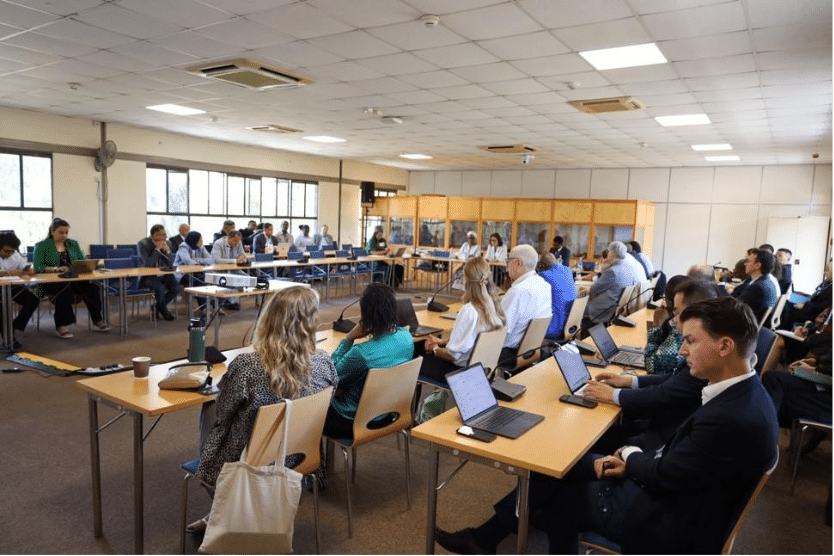
“Africa’s transition to energy-efficient and climate-friendly cooling is well underway. By coupling refrigerant transition with high-efficiency appliances, we can double our impact — cutting emissions, lowering costs, and improving reliability for our communities,” said Fatou Ndoye, Deputy Director, UNEP Africa Office. “Regional harmonization, as seen in the EAC and Southern African Development Community (SADC), shows the power of collaboration to turn global ambition into local transformation,” she added.
Speakers from UNEP, UNIDO, Collaborative Labelling and Appliance Standards Programme (CLASP) and national governments, including Nigeria, Ghana, and South Africa, emphasized the importance of linking refrigerant transition with appliance efficiency to maximize both environmental and economic benefits. The session highlighted global best practices and national examples demonstrating how harmonized regional frameworks can accelerate policy adoption and enforcement across Africa.
Liazzat Rabbiosi, Chief of UNIDO’s Montreal Protocol Unit said: “The adoption of harmonized regional MEPS and labelling marks a major milestone for the EAC region. It reflects strong political commitment and a shared vision for efficient, affordable, and climate-friendly cooling. By aligning standards, countries can create economies of scale, reduce costs, and open markets for cleaner technologies. UNIDO remains deeply committed to supporting these efforts through policy development, capacity building, and investments that drive sustainable industrial growth,” she added.
Driving Africa’s Cooling Transformation
Both events reaffirmed UNEP and UNIDO’s shared commitment to supporting African countries in implementing the Kigali Amendment through efficient, low-GWP cooling solutions. The outcomes from Nairobi will guide follow-up technical assistance and strengthen regional collaboration through EACREEE, SACREEE, and other partners, ensuring that efficient, affordable, and climate-friendly cooling becomes a reality across the continent.
For more information, contact:
UNEP-U4E: [unep-u4e@un.org]
UNIDO: [montrealprotocol@unido.org]
About UNEP-U4E and UNIDO
UNEP-U4E promotes energy-efficient appliances and equipment globally.
UNIDO advances sustainable industrial development.
Together, they support Africa’s transition to low-emission technologies.


Leave a Reply